
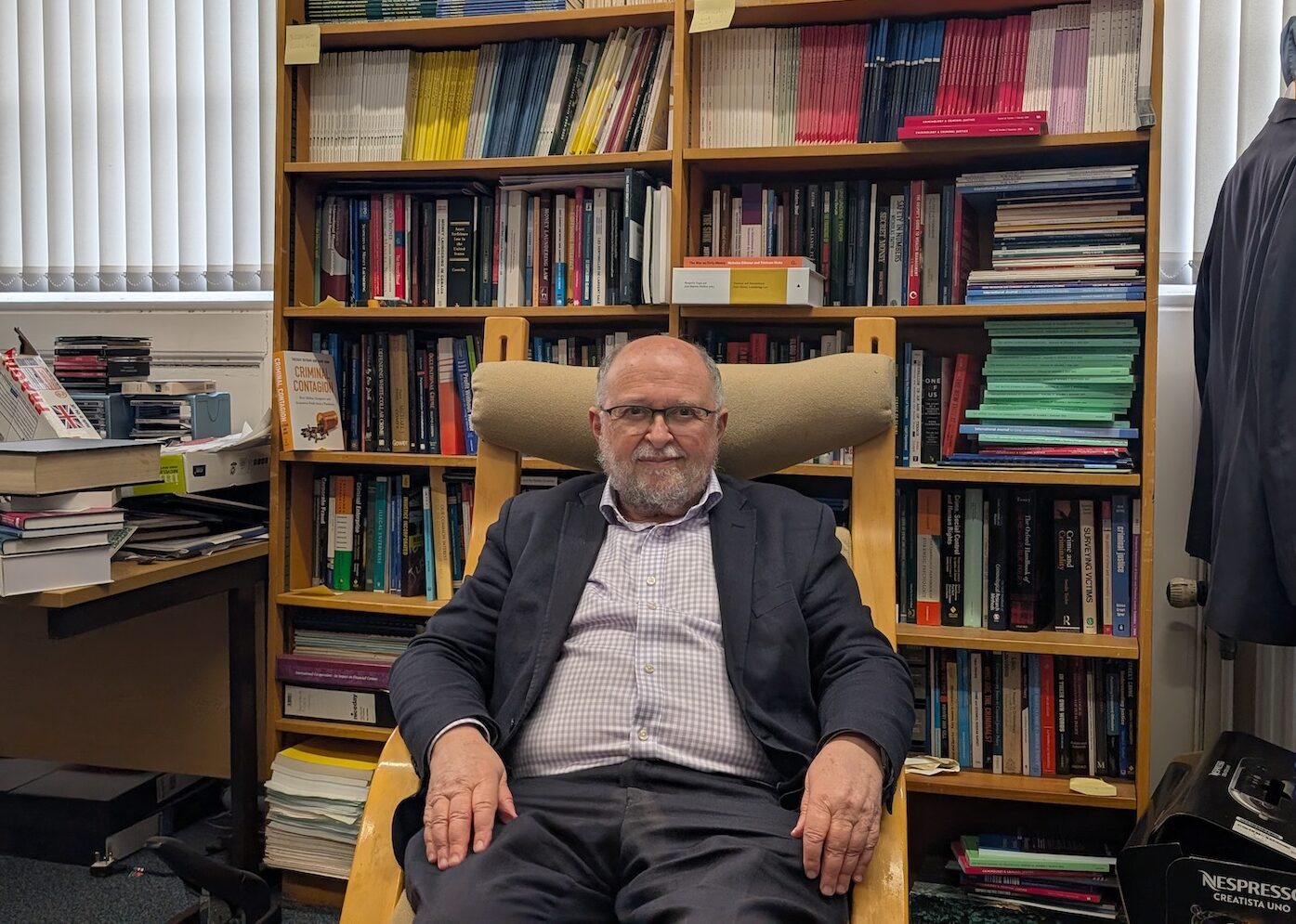
On April 15th 2026, I traveled from Barcelona to Cardiff University to visit Professor Michael Levi. Having spent the past two years—and the last year most intensively—immersed in his criminological work, my primary objective was to interview him and delve deeper into his extensive body of work, perhaps the most extensive in the field of white-collar and organised crime.
Reading Levi’s work is a challenging task for several reasons. First, his pioneering interest in «long-firm» (insolvency) fraud established him as a specialist in a domain characterized by extreme complexity and a «hard-to-reach» population of white-collar and organized crime figures. For decades, he remained one of the few (if not the only) criminologists dedicated to this topic.
Second, while Levi has authored two seminal solo monographs and co-authored several others, the breadth of his thought is distributed across a vast corpus of high-quality articles and chapters. Synthesizing his perspective requires a meticulous compilation of these disparate sources.
Finally, there is the challenge of Levi’s idiosyncratic intellectual style. His writing is characterized by meticulous, nuanced empirical analysis that often leaves the reader (at least myself!) pondering the broader implications of his findings. While he frequently offers brilliant theoretical insights—typically at the margins of his work—they often serve as synthetic captures of the aporias and complexities of the subject. As such, the reader is often left with a sense of theoretical longing, searching for a more expansive framework to navigate the sheer richness of his analytical accounts.
I’m at the airport coming back to Barcelona, and I will finish this as soon as I can, but there is an interview of 3 hours to be transcribed, and many notes in my notebook to be read and think about them.
